Story
It is said that the soul weighs only 21 grams, symbolizing the weight of life and the separation of the spirit.
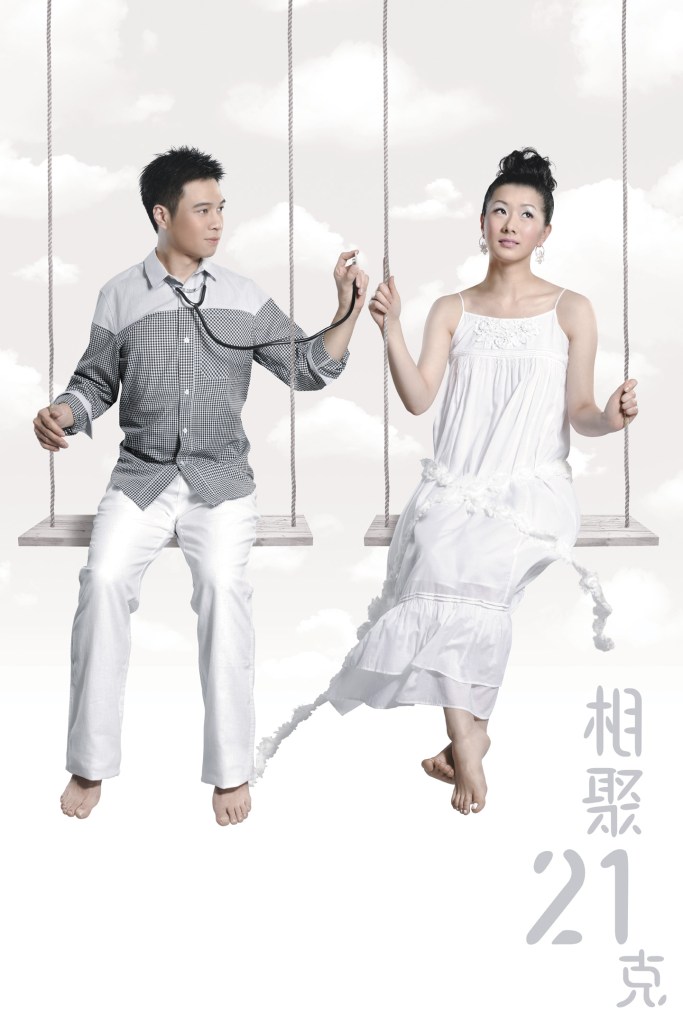
Three years ago, Pui Man’s boyfriend tragically passed away in a car accident. Yet in all these years, she has firmly believed that he never truly left her. Though those around her cannot see the “cohabiting boyfriend" she speaks of, Pei Wen still feels incredibly happy.
Psychiatrist Ho Yin has been living with his girlfriend Ah Sze for years. The monotony of their decade-long routine has gradually worn away their love. One day, by chance, Ho Yin meets his longtime friend, Pui Man. Initially, he treats Pui Man as just another patient, but as he slowly steps into her world, he ultimately comes to see the “him" that Pui Man has always spoken of—the one who doesn’t exist.
Is it all due to an unwavering devotion to love? Or can souls truly be reborn through love?
Director’s Note
A year ago today marked the premiere of Soulmate. This year, the play is being staged again—a coincidence and a stroke of luck. The premiere had an excellent box office turnout, with five sold-out performances and additional standing-room tickets. Despite lacking an award-winning cast or a major promotional campaign, this collaboration between the amateur troupe Chasing and the semi-professional theatre organization iStage achieved remarkable success. More importantly, the audience response was overwhelmingly positive. The play’s content, presentation, and the actors’ moving performances deeply touched them.
In fact, the true premiere of this play dates back to 2003, when it was co-produced by the Hong Kong Academy for Performing Arts’ Drama School and Chung Ying Theatre Company. The play’s origins go even further back to 2001, when it was first introduced in a script reading session at Chung Ying Theatre’s New Play Reading event on Po Lo Road. At that time, the play was titled Without You… Or With You. Over the past decade, the script has undergone multiple revisions—public readings, staged readings, audience and industry feedback, and further refinements—before its official premiere. By the time it was staged in 2009 under the name Soulmate, the script had gone through five major revisions, evolving from a new work into a mature play.
Today, many frequently performed translated plays in Hong Kong have undergone similar development processes. This journey is long and requires perseverance and continuous creativity from the artists involved. It also demands resources and the right timing.
What scale of production does creativity require? Perhaps this is the question we, as creators, are exploring as we restage Soulmate. Over the past year, the theatre scene has undergone significant changes—limited venue availability, overlapping performance schedules, stagnant audience numbers, and divided attendance among productions. These factors require careful consideration in staging a play. However, we firmly believe that the script is the most crucial element of any production. Our decision to restage Soulmate is not only about sharing a well-crafted production with audiences again but also about reaffirming that a strong script remains compelling and performable, even after years have passed.
Collaborating again has been a joyful process—thank you.
Pain Cannot Be Forgotten
To love someone is to rely on memory to hold onto them.
Sometimes, failing to understand love leads to hurting those who should be cherished. That pain, ironically, becomes an indelible mark in memory.
I admit that I have wronged the person I love. In the past, I believed that longing alone was enough to sustain love. But I have come to realize that love requires action.
Hurting someone doesn’t necessarily take courage—carelessness is enough. But loving someone doesn’t require immense bravery either. It only takes small gestures that create lasting memories—like what the character Pui Man does in the play, leaving an impression that others find “strange,” or what Ah Sze longs for—simple acts of love, like singing a song, whispering a few words of affection, or drinking a bowl of soup made with care.
I dedicate this play as a reflection on my relationship with my wife. I hope that in the days ahead, I can give her more love and cherished memories, rather than pain. At the same time, I am grateful for her patience, understanding, and all that she has given me.
I love you.
Production of iStage
Priemere: 24 – 27 September 2009 / Studio Theatre, Hong Kong Cultural Centre
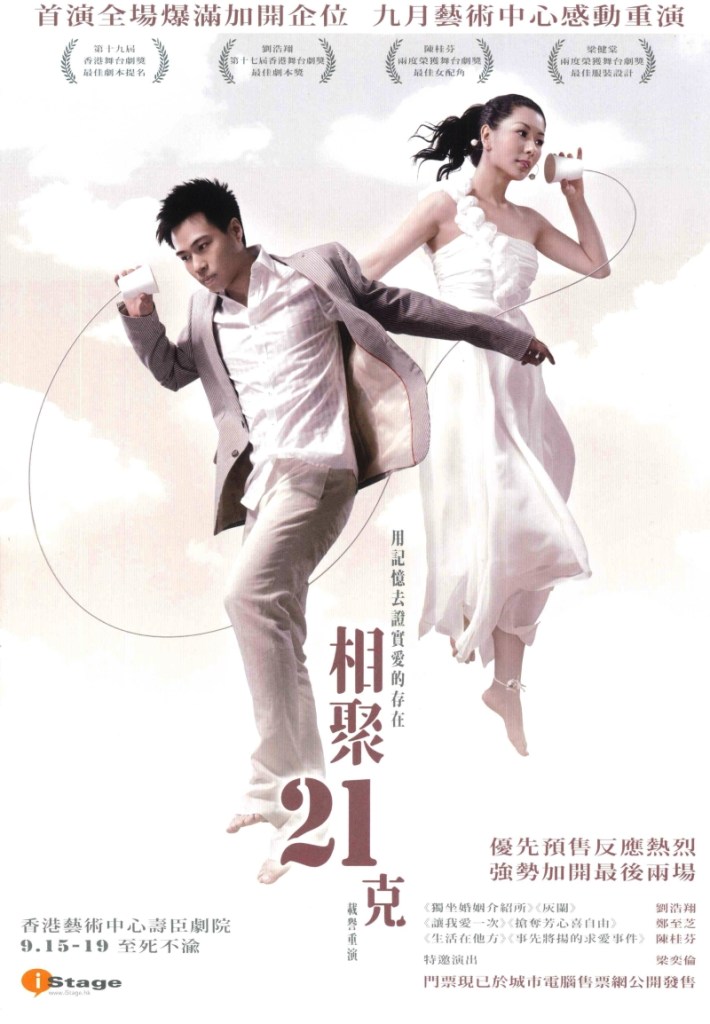
Re-run: 15 – 19 October 2010 / Shouson Theatre, Hong Kong Arts Centre
Playwright: Elton Lau / Director: Indy Lee
據說靈魂只重21克,這代表著生命的重量,也是靈魂分離的象徵。
三年前,佩雯的男朋友不幸在車禍中去世。然而,在這三年間,佩雯一直深信,他並未離開她。雖然她身邊的人都無法看到這位她口中的「同居男友」,但佩雯卻感到無比幸福。
精神科醫生浩然與女友阿思已同居多年。隨著時間推移,十年如一日的生活逐漸磨滅了他們的愛情。在一次偶然的機會中,浩然重遇多年好友佩雯。起初,浩然只是將佩雯視為病人,但隨著他逐步進入佩雯的世界,最終他竟然看到了佩雯所描述的那個「並不存在」的他。
這一切,究竟是對愛的執著所致?還是靈魂真的可以因愛重生?
導演的話
去年今日,剛好就是「相聚21克」首演的日子。今年,此劇可以再度公演,真是既巧合又幸運。首演的票房很好,五場演出爆滿之餘,還要加開企位。去年的製作,在沒有得獎無數的陣容,沒有強大的宣傳攻勢,只由一個業餘劇團 (楚城) 跟半職業的劇場組織 (iStage) 合作的演出,在票房上能有這成績,是難能可貴的。而更重要的是,觀眾的反應亦很好。此劇的內容,表現手法及演員動人的演出,深深的感動了他們。
其實,此劇的「真正」首演,是要倒數至2003年。當年,由香港演藝學院戲劇學院及中英劇團共同製作的。而此劇面世,更要倒數至2001年,由中英劇團主辦的「新劇波地」,在波老道的圍讀展現。那時候,此劇是叫「沒有你….. 還是有你」。回顧過去的十個年頭,此劇本經過,公開圍讀,圍讀展現,吸取觀眾及劇界的意見,修改再修改,再正式公演。2009年公演時,此劇改名為「相聚21克」。那次演出,這劇本無論是叫「沒有你….. 還是有你」或是「相聚21克」已經歷了五稿的修訂,由一個新劇成為成熟的劇本了。
現在,在香港常被搬演的翻譯劇,大多數也是要經過以上類似的發展過程。這過程是漫長的,而且亦需要創作人員的毅力及源源不絕的創意,才可以得到。同樣,亦需要資源及時機的配合。
創作需要一個怎樣規模的製作﹖或許,這是我跟創作人員要重演「相聚21克」的共同探索的課題。在過去的一年裡,劇圈有很大的變化﹕場地提供只限於僅有的演期,演出節目打對台,觀眾人數沒有增加,而劇團演出彼此分薄了入座率……在製作上,要有很多的考慮。但我們亦相信,「一劇之本」才是製作中最重要的元素。我們重演「相聚21克」,不單想再次跟觀眾分享好的製作,更重要的是透過製作,去認定一個好劇本,就算經年濾月,在創作上仍是有可觀性及可演性。
再一次合作,是愉快的過程,多謝。
傷痛是不能忘記的
愛一個人是要靠記憶去記住的。
有時候,不懂去愛,傷害了身邊應該去愛的人。那種傷痛,反而令對方記著,在記憶中不能磨滅。
我承認,這是我虧欠了所愛的人。過去,以為單靠思念去愛就足夠了。原來不是,還要行動。
傷害人不一定要勇氣,粗心大意就可以了。但愛一個人,亦不一定需要很大的勇氣,只要肯去作一些可以令他思念的事情,那就夠了。可以像劇中角色「佩雯」所作的,令人覺得「怪異」,又或像「阿思」所需要的 – 只要所愛的人親力親為,唱一首歌,說一兩句情話,喝她親手煲的湯,就可以甜上心頭了。
我以此劇,作為我跟太太關係的反思,希望未來的日子,能給她更多的思念和愛,而不是傷痛。同時,亦感謝她在過去對我的付出、耐心及體諒。
我愛你。
iStage 製作
首演﹕2009年9月24-27日 / 香港文化中心劇場
重演﹕2010年9月15-19日 / 香港藝術中壽臣劇院
編劇﹕劉浩翔 / 導演﹕李俊亮
 INDY LEE 李俊亮